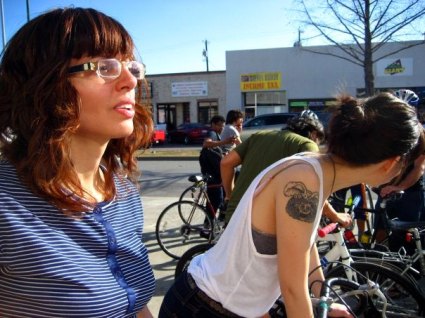
Lydia Pierce, a former Dallasite who recently moved to Portland, answers a few questions for BFOC regarding the differences between pedaling in the “worst city for bicycling” vs. the “bike friendliest” city in the nation.
What is it that makes Portland more appealing for you to bicycle in, over Dallas?
I bike more often here because there is more to do within biking distance. If I know a place is within 2 miles of my house I know I can bike there safely. Portland is so condensed that there are a ton of cool bars, restaurants, and shops within 2 miles of my house. In Dallas all of the places I preferred to hang out were miles and miles away from my place. Many were on the other side of Dallas. It just wasn’t practical to ride my bike.
I bike more here because there is a cycling community. A few examples of how this has worked in my life: I told my friend Amanda my bike was in disrepair and she gave me the number of her friend who does $30 tune-ups. Also, I got a flat tire and my friend Cat came over to my house and we walked my bike to the Community Cycling Center. I paid $2 for a new inner tube and $4 for the plastic clamps to help get my tube out. Cat taught me how to change my tire out of the goodness of her own heart. She also received a minor repair on her bike at the Cycling Center FOR FREE! A donation was suggested by the repairman. Cat decided to donate a few dollars. I live one block away from Bike Farm, another cycling center Cat has recommended to me, but I have yet to visit.
I bike more here because I’m aware of safer cycling. It’s against the law to not have flashing lights on your bike here. After driving my car and cursing the cyclist that did not have these lights I understand why they are needed. A cyclist is totally invisible without these lights at night. I’ve had to come to a screeching stop a few times because of irresponsible cyclists. Driving around cyclists changes your consciousness. I always have to check my rearview mirrors now to make sure I don’t turn or back up onto a cyclist. I know that some cyclists are better at making sure they are seen than others. I try to stay aware at all times. That’s how drivers in Portland drive. I feel as if cyclists and pedestrians have the right-of-way here. Many times I feel like people are not afraid of cars. They know most Portland drivers will take the effort to see them. So cyclists feel comfortable.
I bike more often because there are bike lanes everywhere. I look around and make mental notes of which streets have bike lanes. It’s comforting to know that cycling on that street is an option. I also am aware of which streets don’t have bike lanes. I make mental maps of residential streets I can use my bike on to avoid those major streets. Web sites like http://bycycle.org/ have been a big help. So has the bike-friendly map I got at the Community Cycling Center.
I bike more here because it’s infectious. A friend invited me to the Midnight Mystery Bike Ride. On the 3rd Friday of every month a meeting place is announced on the Mystery Bike Ride Blog. Everyone shows up there and at midnight a mysterious bike ride starts. No one knows where it will end and there’s usually a keg at the stopping place. I went to the Halloween-themed ride. There were at least 200 people there. There were lots of freak bikes and some were towing subwoofers and speakers. It was so nice to ride in a big group and had fantastic italio-disco/electro music as a soundtrack. That night was madness and left such a good taste in my mouth for cycling in Portland in general. People are crazy here, and I love it.
Do you feel that the city’s commitment to bicycle infrastructure has increased your likelihood of bicycling? If you could make improvements to the current infrastructure, what would they be?
I’m not sure if it’s in Dallas’s culture to fully embrace cycling. Portland is a more European city. Recently the Dallas Morning News compared Dallas and Portland. That article stated: “Seattle and Portland received much of their initial migrants from the northern tier of America, which has always been heavily Germanic and Scandinavian.” Many people are of European heritage and embrace European things. Many people say Portland reminds them of Amsterdam. I think the European heritage is part of the reason.
That said, I think Dallas could make some changes to improve cycling, but I think it has to market itself in a different way. I think people who are comfortable in their cars will be wary of the need to put money into cycling infrastructure. I wish there were an effective way to speak to low-income families and minorities and teach them why cycling is important and how to do it safely. Class issues are so strong in Dallas. If cycling is marketed to low-income families and minorities, the high-class, SUV-driving families won’t want to support it. If it’s marketed to higher-income families the lower class will be left out in the cold. They’ll be uninformed and won’t see the need for better cycling infrastructure and won’t know how to use it if it ever came to be.
From what I have observed, inner Portland is made up of mainly middle and upper class people. They are educated, love all things European, and understand a need for cycling infrastructure. The really, really poor families in the Portland area live in smaller cities outside of Portland. They don’t use bikes and see no need.
Portland only has about 500,000 people. Dallas has about 1 million. I don’t really think what’s effective in Portland is feasible in Dallas. Maybe Dallas should take cues from what bigger, more diverse cities, like Chicago have done to improve cycling.
I think that if Dallas were to put more money into cycling they should start with bike lanes. Just seeing that paint on the street is inspiring for some. Then there needs to be a lot more education on safe cycling. People don’t know how to signal they are about to turn or stay out of blind spots. They don’t know how to respect cars as they turn or stay aware of people opening their car doors suddenly. People need to be informed. I think free lessons would help. Cycling centers like the ones here in Portland would help. I also think motorists need to become more informed. Dallas is huge and there are drivers from all over Texas driving in Dallas every day. Some drivers are just completely unaware of cyclists. Big huge trucks definitely have the right-of-way in Texas, not cyclists or pedestrians. That’s just the culture of Texas. It’s going to be hard to change the culture of the whole metropolis.
When given the choice of bicycling on a major street with a bike lane, or one without, which do you prefer to bicycle on?
It depends. I personally prefer to cycle on residential streets without much car traffic. There are a lot of busy streets here with safe bike lanes, but I just prefer to take an off-road that is parallel. It just depends on what kind of cyclist you are.

 Bike Friendly Oak Cliff
I gotta say, that assessment sounded halfway racist. European influence has nothing to do with Portland’s successes. Portland’s very own local leaders made some wise choices in the 1970s and 80s that sent the city down a very different developmental path than most other American cities. Dallas is not a lost cause, but one of the biggest hurdles to developing a more vibrant bicycling cultures here is the (false) notion that other places are just somehow different than us. I’m convinced that anything Portland can do, we can do better (eventually).
Portland is so condensed that there are a ton of cool bars, restaurants, and shops within 2 miles of my house. In Dallas all of the places I preferred to hang out were miles and miles away from my place.
This confuses me. Is there a particular reason you lived in the neighborhood in Dallas that you did? I’m sympathetic to how frustrating it can be to live far from the places you want to go; but at the same time, I wonder why you didn’t live in the neighborhood with the places where you preferred to hang out to begin with?
I don’t like that Portland isn’t as diverse as Dallas. Maybe I didn’t make that clear.
I lived in Lower Greenville, near Good Records. I liked hanging out in Expo Park and Bishop Arts. I just wasn’t aware of safe routes to my favorite spots, especially at night.
[…] Dallas to Portland transplant discusses differences between cycling in both cities at Bike Friendly Oak Cliff Lydia Pierce, a former Dallasite who recently moved to Portland, answers a few questions for BFOC regarding the differences between pedaling in the “worst city for bicycling” vs. the “bike friendliest” city in the nation. […]
[…] Dallas to Portland transplant discusses differences between cycling … What is it that makes Portland more appealing for you to bicycle in, over Dallas? […]
Rob – As a Portlander, there are a couple of things not really covered in the article, that might help you understand the difference.
Portland is also a very pedestrian friendly city, and many of the things that make it pedestrian friendly, inherently make it bike friendly. Planning, codes and laws do a lot towards making it walkable and bikeable. One small example is that “snout” houses (houses with the garage sticking out front) are not allowed to be built and a certain amount of glass is required to face the street. Just picture the difference of walking down a street, where all you see are driveways and garages, with entrances to narrow walkways leading back to front doors. Or even worse, as I see in many modern southern cities, miles of cement block wall, leading to large intersections with a huge strip mall on each corner. In Portland you walk down a street, you see people. People sitting on their front porches, people in their front yards and even people sitting in windows that are close to the street. Streets are lined with homes and small businesses (think old fashioned storefront) like sidewalk cafes.
Palchik was partially right in that some very wise leaders made some very good decisions in the past. But, I believe that one of the reasons that those decisions were embraced was because of the European heritage.
That brings me to to my 2nd point and that is that as Portland grew, the immigrants from the different countries were quite segregated and each had their own little neighborhood center in their own little neighborhoods. The neighborhoods have desegregated, but the neighborhood centers remain and everyone has at least one within walking distance. So, almost everyone has “a ton of cool bars, restaurants, and shops within 2 miles of” their homes. In many cities, these cool charming neighborhood centers are few and far between and not affordable, except by a select few.
Here are 3 of the cool places in 3! separate neighborhood centers within easy walking distance of my house and I live in probably about the most uncool and least desirable (also least expensive) areas of Portland there is. Of course, easy biking distance is much further.
http://www.deltacafebar.com/
http://www.arletalibrary.com/
http://www.barcarlo.com/index.php
Welcome to Portland Lydia!!!